
CR's troubles - South Africa's investment case is about to be rewritten
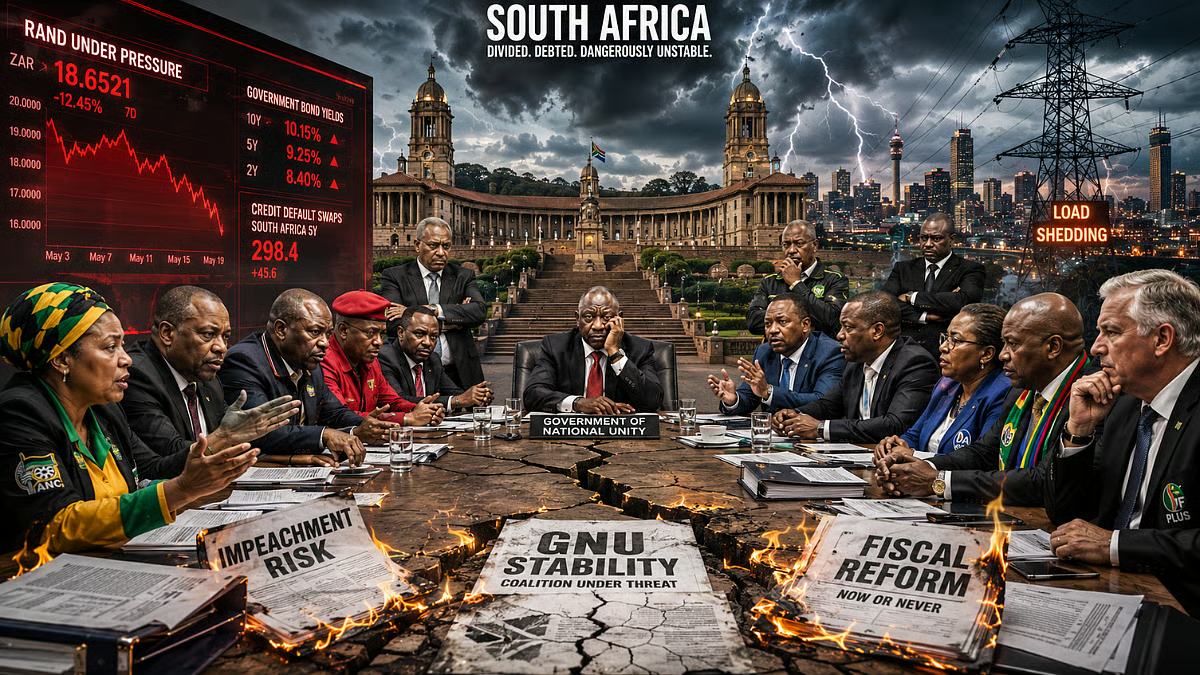
ConCourt ruling revives impeachment risk, testing GNU stability and reform outlook
For the past eighteen months, South African investors have been running a relatively comfortable thesis: that the Government of National Unity (GNU), for all its contradictions and coalition noise, would hold together long enough to sustain the reform narrative that began with the 2024 elections: gradual fiscal consolidation, incremental structural reform, and the preservation of institutional credibility. It was never an exciting story, but it was coherent enough to justify a slow compression of the risk premium on South African assets.
The Constitutional Court has put that thesis under serious strain.
The ruling that Parliament’s 2022 vote to shelve the Section 89 Independent Panel report was unconstitutional does not, by itself, remove President Ramaphosa from office. But it reopens an impeachment process at the worst possible moment: inside a coalition already negotiating its second-year tensions, in a local government election year that will redraw the political map, and at a point when global conditions are already testing emerging market resilience. The combination of these pressures – legal, political, and electoral – is more consequential than any one of them in isolation.
The channels through which this flows into asset prices are not complicated. Presidential bandwidth is a finite resource. A head of state managing an active impeachment process in Parliament, while simultaneously navigating GNU coalition arithmetic and preparing his already-under-great-pressure party for the LGE, is not a head of state with the political capital to push hard on fiscal consolidation, merit-based appointments, or structural reform. These are not background issues for investors; they are the entire basis on which the post-2024 re-rating of South African assets was justified.
There is also a coalition dimension that markets have not fully priced. The DA’s leverage – provided it is willing to use it – inside the GNU increases as the ANC’s domestic position weakens. That leverage can be used constructively – pushing harder on accountability, on the anti-corruption agenda, on property rights. Or it can become a source of instability if the ANC’s internal factions respond to the impeachment pressure by lurching toward their base rather than their coalition partners. Which direction the GNU moves under this kind of pressure is precisely the question that should be driving portfolio and capital allocation decisions right now. The Centre for Risk Analysis’s latest briefing, Ramaphosa's Nkandla Moment, maps the parliamentary and legal tracks running in parallel, and lays out the specific votes, dates, and committee arithmetic that will determine the outcome.
The historical parallel is worth stating plainly. The Zuma years demonstrated that political risk in South Africa is not a soft overlay on the macro view; it is the macro view. The rand, the bond curve, and business confidence do not move on economics alone; they move on the credibility of the executive and the stability of the institutions around it. The post-2024 period has been different precisely because those credibility signals improved. The question now is whether that improvement was structural or cyclical.
Between now and 4 November – the country’s next local government elections – South Africa will produce the answer. The base case remains a managed process: Parliament works through the committee stage, the coalition holds, and investors treat the episode as a political distraction rather than a structural break. But the downside scenario, in which the impeachment process fractures the GNU and accelerates ANC factional realignment, carries real consequences for growth, fiscal credibility, and the cost of capital. The upside – a clean process that reinforces institutional accountability and strengthens genuine reformist figures and impulses – is also possible, and would justify a faster re-rating than the market currently contemplates.
Teams that engage with this framework now will recognise the inflection points before they show up in the rand or the curve. Those waiting for the price signal will, as usual, be reacting rather than positioning.
South African political risk is back at the centre of the investment case. The next two quarters will determine which version of this country investors are holding.