
Political risk is a business problem, not just a headline
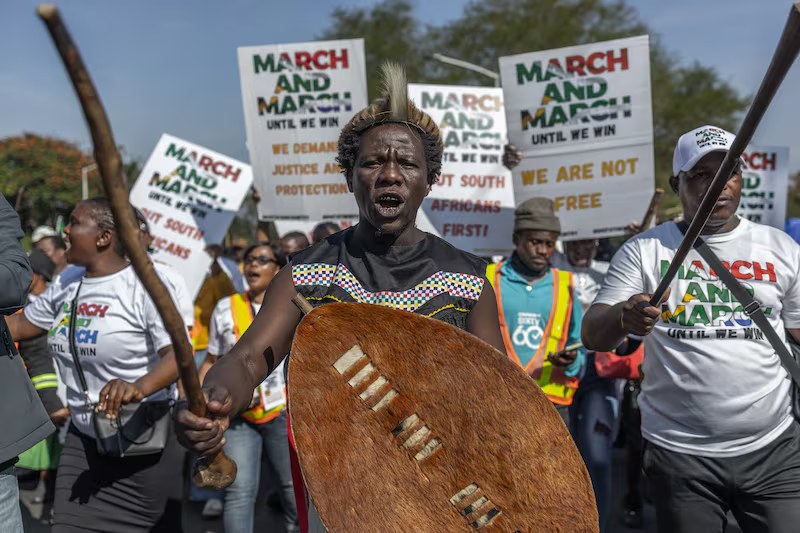
Operation Dudula and March and March are not political parties but they closed shops, disrupted supply chains and triggered a migrant exodus.
Run through the major headlines from the first half of this year. A cabinet reshuffle that reordered five ministries inside a coalition still finding its footing. Anti-migrant marches that shut down city centres, closed shops nationwide and sent tens of thousands of migrants towards the borders before a self-declared June 30 deadline.
A war between the US-Israel and Iran that closed the Strait of Hormuz, sent Brent crude above $100 a barrel and rerouted global shipping around the Cape. Local government election season already reshaping party behaviour ahead of November.
None of this appeared on a company’s balance sheet in January. All of it appeared on someone’s operating statement by July.
Businesses manage financial risk with considerable rigour. They model exchange rate exposure, hedge commodity positions and stress test credit portfolios. But when they turn to political risk they tend to wing it. A CEO reads a headline about unrest in a market his company operates in, asks the local country manager whether things are “fine”, gets reassurance and moves on. It is optimism dressed as judgment, moonlighting as risk management.
The modern definition of political risk is the probability that a political action ― not merely a government action ― could affect a company’s business. The government of national unity reshuffle was intra-coalition bargaining, not government policy, yet it produced the same effect on regulatory certainty.
Operation Dudula and the March and March movement are neither political parties nor government bodies, yet they closed shops, disrupted supply chains and triggered a migrant exodus that reshaped labour availability in agriculture, construction and hospitality within weeks.
The actors involved in the Gulf conflict did not specifically target South Africa, yet the country had to absorb the fuel price shock, the shipping cost increase and the inflationary pass-through anyway. A business that scans only parliament and the Union Buildings for political risk is watching one entrance while the exposure walks in through three others.
Anti-migrant mobilisation
The deeper failure is treating these events as unconnected news items rather than a single, compounding risk environment. A coalition under bargaining pressure delays exactly the regulatory clarity that businesses need heading into an election year.
Anti-migrant mobilisation escalates fastest in the same municipalities where service delivery frustration and unemployment are already highest, meaning the same location carries multiple, reinforcing risk categories at once. External shocks like Hormuz arrive on top of the fiscal environment, with limited room to cushion consumers or industry from the pass-through. None of these risks should be assessed in isolation, because in this economy they rarely materialise in isolation.
Advice I regularly offer to businesses is to be cautious and aware of your own optimism bias. The instinct is to treat each of these events as a one-off, a headline that will fade, rather than evidence of a structural pattern. Companies that build political risk muscle into the same discipline they apply to credit and currency exposure will see the next compounding event coming. Those that wait for the headline will be managing it after the fact, at a cost that was avoidable.
The remedy is institutional, not an attitude that tends to lean towards an optimistic behaviour-driven decision. Political risk deserves the same seriousness financial risk receives. What is needed is scenario planning that tests strategy against divergent political trajectories, not just a baseline case; stakeholder mapping that identifies where regulatory, social and external risk intersect; and analytical capability resourced before the crisis, not assembled during one.
The events of this year were not unforeseeable. They were, in the language of the discipline, precisely the kind of political risk a business is paid to anticipate.
This month Standard Bank, the largest bank on the continent by assets and active in more than 20 countries, created a head of geopolitics role. The role is permanent. It sits alongside the economics, research and risk teams rather than replacing them, and it exists to interpret geopolitical shifts and recommend responses to the group.
Standard Bank is not an outlier either. JPMorgan built the same function before it, and GlobeScan’s 2025 research now ranks geopolitical risk as the single biggest threat businesses report.
When the biggest bank in Africa decides political and geopolitical risk deserves a standing ― senior capability rather than a headline read and forgotten ― that is exactly what I mean by the discipline being resourced before the crisis instead of during it.