
Ronald Lamola is worsening relations with Washington
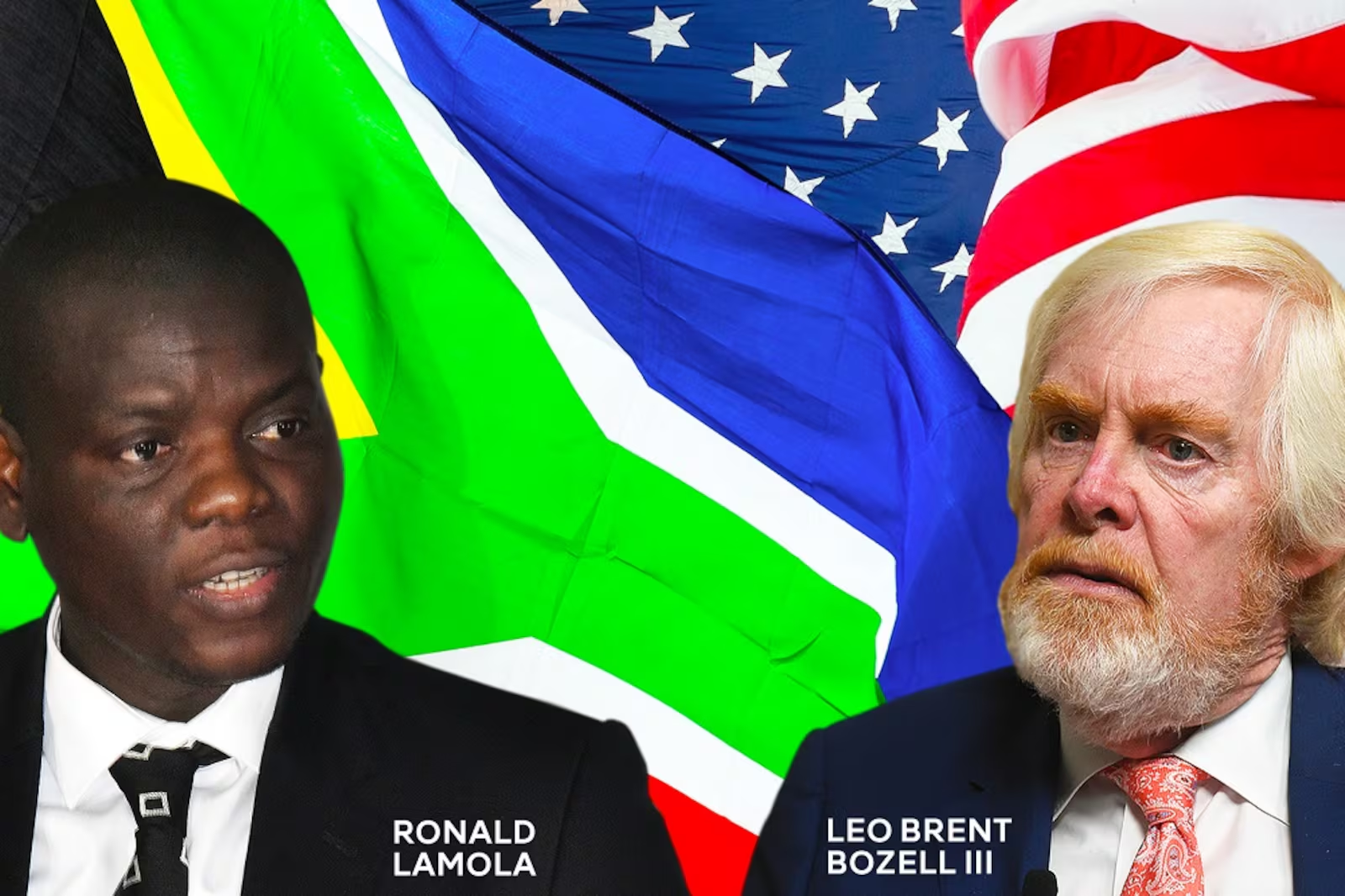
The department of international relations & co-operation has twice this year formally summoned US ambassador Leo Brent Bozell III. On March 11 and again on September 29 he was issued a démarche, a formal protest delivered in person.
Two such protests in seven months signal a hardening relationship that the minister responsible for South Africa’s side is deepening rather than containing. President Cyril Ramaphosa should move minister Ronald Lamola out of the international relations portfolio, not for the démarches in particular but for his overall conduct toward the US.
Because the ANC leads the government and controls that portfolio, appointing a new minister would not on its own change policy or meet Washington’s requests. But keeping Lamola in the post makes things worse. Replacing him would at least stop the harm and might even improve things.
Washington is leaning on a sovereign state with hard measures and its conduct isn’t really in dispute. Dressing up domestic policy requests as human rights concerns and enforcing them with visa bans and tariffs is coercive, and South Africa is entitled to say so.
But naming a wrong isn’t a strategy. Pretoria has correctly identified the mistreatment, but antagonising the country responsible means the harm falls on the people it’s meant to protect. That’s a bad strategy. Pretoria is losing this fight, and it’s choosing to lose it faster.
Washington will exert its extraterritorial reach regardless of who runs South Africa’s foreign affairs. The issue is that Lamola is tasked with mitigating the risk but is worsening it instead.
Not only is he evidently doubtful about the prospect of reducing those risks, but he seems willing to bring them on. Speaking on US soil as the leader of the South African delegation to the UN, Lamola told
SABC News that South Africans should brace themselves for the “worst-case scenario”.
Days earlier, at a Congressional Black Caucus Foundation forum in Washington, he branded the South African minority resettlement programme as “Apartheid 2.0” because it was a “race-based policy”. Interviewed by Business Day, he went further, calling on other countries to unite against President Donald Trump and build an alternative trade order to blunt US pressure.
All of this being uttered within a single week by the country’s chief manager of external risk, while in Washington, makes the minister a political risk to South Africa in his own right. “It’s disappointing to hear him say what he says, and then he wondered why he hit a brick wall when it came to Washington. Well, that’s why,” Bozell has said.
Lamola’s rhetoric seems aimed at a domestic constituency (most likely the ANC’s base) and the anti-Trump gallery. It works for these audiences, serving his and the party’s own interests, but does nothing to settle the impasse between Pretoria and Washington.
His convictions go back a long way. Lamola joined the ANC Youth League at age 13, rose to its deputy presidency alongside Julius Malema, and in 2012 was charged over remarks warning that a failure to transfer white-owned land to black South Africans could bring Zimbabwe-style invasions. Three decades of that conviction are consolidated, conceivably, in his ministerial performance today.
Cognitive mapping helps reveal his reflexes; he was never going to soften his posture towards Washington. This confrontation against a right-leaning administration is possibly the moment his career has been building towards. Explaining the impulse is not excusing it, but knowing why a minister antagonises a vital trading partner is the first step to limiting the damage.
On the merits, both Pretoria and Washington are wrong. The case against antagonising Trump is not a plea to obey him or to surrender sovereignty. It’s that South Africa keeps laws that throttle its own economy and betray its own poor and chooses to take a penalty rather than change them and then lets its foreign minister inflame the confrontation.
Reform that should have happened years ago, on principle, will now look like surrender to Trump if it comes at all. The requests have made the right thing harder to do by making it look like surrender. But the case for that reform was never Washington’s to make; it’s South Africa’s own, and South Africans have already made it.
March 2026 polling by the Institute of Race Relations found that 70% of registered voters want the government to stop using apartheid-era race categories to decide who gets a job or a contract, including 64% of black respondents. The mandate to end race-based law is domestic and doesn’t depend on an executive order from the White House. Race-based laws, which Lamola himself is open to criticising when applied by another country, should go because they harm South Africans.
A 2026 report by IRR Legal found that the group facing the greatest impediment to promotion in the police service, the country’s largest employer, is black South Africans. More than 40,000 black officers were held back by the over-representation rules of the Employment Equity Act, against about 12,600 white officers.
The obvious suggestion to Pretoria is to retire race as the test for opportunity and help the poor by need rather than by pigmentation. That decision can only be made inside the ANC, so realistically it is a long shot. The more limited and achievable suggestion is to stop amplifying the risk by replacing Lamola with a successor who can at least hold the same position soberly and stop handing US secretary of state Marco Rubio fresh ammunition every week with soundbites meant to disrespect the US administration.
South Africa doesn’t need a minister who folds. It does, however, deserve one who grasps that his or her first duty is the national interest, not the party’s. Ramaphosa has the power to make that change and, as the president who owns this relationship, the responsibility to do so. Of course, even if Lamola were moved, the impasse would persist because his replacement would come from the same party with the same values. However, a minister who holds the line without the insults could reopen the channel Bozell says has hit a brick wall.
A calmer relationship would also give Pretoria room to pursue the reforms it needs on its own terms so that ending race-based laws reads as sovereign self-interest rather than surrender. The best case would be a successor willing to make those reforms for our own economic sake without handing Washington a victory lap.
Article originally appeared here.