
Tau is right about the decline, but the remedy misses the cause
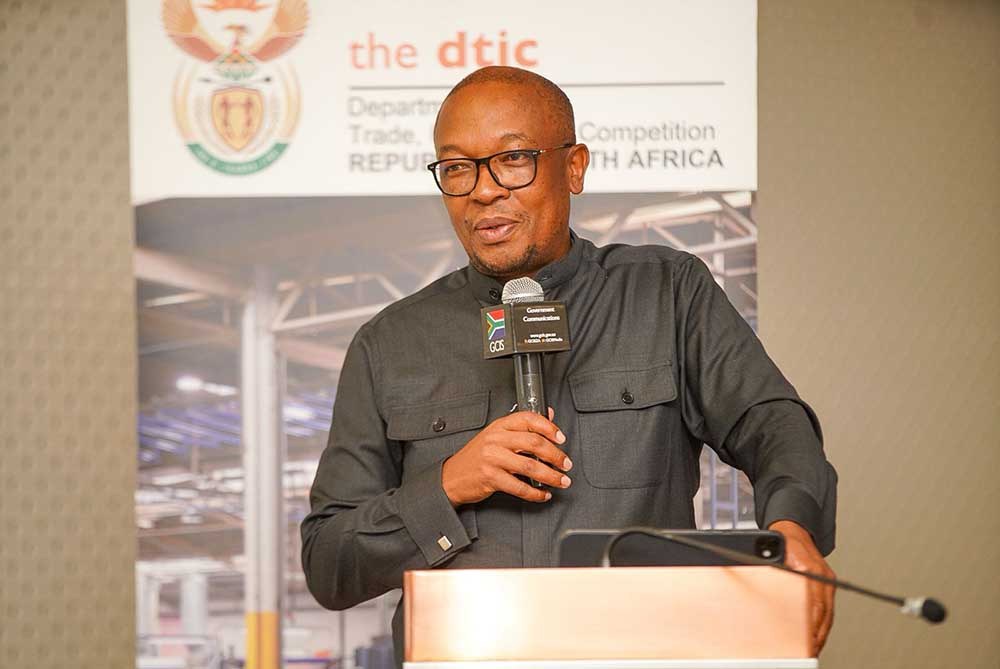
Parks Tau, Minister of Trade, Industry, and Competition, told a defence industry conference in Pretoria this week that South Africa must confront three decades of decline in its arms industry. Defence force acquisitions from local manufacturers fell to R850m in 2017 from R26.2bn in 1989/90. Over the same period research and development funding dropped to about R500m from R6.1bn. Employment across the sector collapsed from 130,000 people across 3,000 firms in 1990 to 13,000 people across 600 firms today.
These numbers deserve the attention Tau gave them. Too few ministers say plainly that a strategic industry has been gutted on their party’s – the ANC’s – watch. So, some credit where it’s due.
The trouble starts with what he proposes instead. Tau wants a “South Africa Inc” co-ordination model, arguing the sector’s real problem is that the trade and industry department, defence, and other arms of government have not pulled in the same direction. He invoked the Second World War, when American war production dragged the United States out of depression and into industrial supremacy. The argument runs: get the state’s machinery aligned, and defence manufacturing becomes the catalyst for which the broader economy has been waiting.
This is the wrong lesson from the wrong war. Wartime America mobilised idle capacity inside a system with secure property rights, enforceable contracts, and a currency the world trusted. It did not need to solve a governance crisis at its shipyards before it could build ships. The Centre for Risk Analysis’s June 2026 review of the South African defence sector, including South African National Defence Force (SANDF) funding, shows what South Africa’s version of that governance crisis looks like. Defence spending sits at 0.7% of GDP, against a continental African average of 1.5% to 1.8% and a NATO benchmark of 2%. Had 2016/17 funding levels of 1.05% of GDP simply been held, the defence budget today would be R73.9bn rather than roughly R58bn. The CRA puts the cumulative shortfall against what the force actually needs at close to R39bn.
That underfunding does not fall evenly. Personnel costs eat up nearly two thirds of the defence budget, which leaves the remainder to cover maintenance, spares and new equipment for a force of just under 70,000 people carrying a fifth of its posts vacant. Engineers are the scarcest of all, with a vacancy rate above 46%. The consequences show up in the numbers the department would rather not publish alongside its speeches. The air force flew 6,209 hours in 2024/25 against a target of 12,000. The navy logged 3,717 hours at sea against a target of 8,000. Of 26 Gripen fighter jets, only a handful are serviceable enough to fly on any given day. Three of four Valour class frigates sit unable to deploy.
The department’s own reporting compounds the problem. The Auditor-General’s office told a parliamentary committee on 27 May 2026 that air border patrol performance had been recorded as improving from zero in the second quarter to full achievement in the third – a shift the office found rested on a single patrol. A department that cannot count its own patrols honestly is not simply short of money; it is short of the basic administrative discipline that any co-ordination model must assume is already in place before it can work.
None of that is a co-ordination problem. Rather, it is a state-capacity problem. Consider what drove firms and engineers out of the defence industry over the past thirty years. Subject to the same budget raids and politically directed contracts that have hollowed out Transnet, Eskom and SAA, procurement has been unpredictable for a generation. Layered on top of that is broad-based black economic empowerment, which applies its ownership, management control and procurement scorecards to defence contracts exactly as it does across the rest of the economy. A firm bidding for state defence work competes on BEE compliance as much as on engineering merit, and a specialist engineer with scarce, exportable skills weighs a South African career against BEE-driven ownership and hiring constraints that do not exist in London, Abu Dhabi or Riyadh.
Tau’s own words concede the mechanism: once that expertise leaves, he said, it does not return quickly. He is absolutely right. It left because the state, through BEE requirements as much as through Denel’s collapse and chronic underfunding, made staying more expensive and leaving easier, and it has not reversed any of the three.
Exports – which Tau correctly noted account for more than 80% of the industry’s remaining revenue – tell the same story. The part of the sector that has survived is the part least dependent on the South African state as a customer, and least exposed to BEE conditions attached only to domestic state contracts. That serves as evidence that private firms selling into a global market, on their own steam, are the only part of this ecosystem still functioning.
A hollow claim to middle power status
There is a broader stake here than industrial policy. South Africa positions itself as an aspiring middle power. It held the G20 presidency last year, sits inside BRICS, portends to lead mediation efforts on the continent, and contributes troops to African Union and Southern African Development Community peace missions. Every one of those roles rests on an assumption that South Africa can back its diplomacy with credible capability, whether that is a naval presence that can protect the Mozambique Channel and the sea lanes around the Cape, or an air force that can move troops and supplies into a mission area on schedule.
A navy that managed 3,717 hours at sea last year – less than half its target –with only one of three submarines even semi-operational, cannot sustain that role. An air force that flew half its target hours, with the bulk of its Gripen fleet grounded for want of serviceable airframes, cannot either. A force that cannot count its own border patrols accurately is not a force that can be trusted to report honestly on a peace mission. Middle power status is not conferred by a seat at a summit table. It is earned by the capacity to act when a mission requires it, and South Africa’s is eroding by the year.
Africa’s defence acquisition market is forecast at roughly $136bn. Mr Tau is right that countries with sovereign design, manufacturing and maintenance capability will capture a share of that demand, and that those that lack, it will not. A domestic industry with that capability is also what gives a middle power the freedom to arm and equip its own military on its own terms, rather than depending entirely on foreign suppliers whose willingness to sell can shift with geopolitics. Losing that capability, as South Africa has over three decades, does not only cost jobs and export revenue. It narrows the country’s strategic options at the exact moment it wants to be taken seriously as an independent voice in a fragmenting global order.
What should follow
Capability is not summoned by an implementation model or a lekgotla resolution. It is built by specific, unglamorous fixes government has avoided for years.
- Fund the SANDF to the level the president himself has already conceded is overdue, through a multi-year appropriation that cannot be raided mid-cycle the way compensation overspending has already produced R2.51bn in unauthorised expenditure in a single year.
- Resolve Denel’s ownership and governance rather than continuing to bail it out. Rather than repeated Treasury transfers, private capital and a credible partner is the only route back to a functioning state-linked prime contractor.
- Apply defence procurement rules that select on engineering capability and delivery record, with empowerment objectives that reward skills transfer and local employment rather than ownership and management scorecards that push scarce engineers out of the country.
- Require the department to report performance against indicators that the Auditor-General signs off as methodologically sound, with consequences for the kind of reporting anomaly flagged in May 2026, before any new co-ordination structure is layered on top of numbers nobody yet trusts.
- Back export-oriented private defence firms with the tools that help them compete abroad, export credit, diplomatic support for foreign sales, and streamlined export licensing, rather than trying to recreate state-led demand that the fiscus cannot afford.
None of this requires a new department, a new lekgotla, or a new co-ordination model. It requires the state to stop doing the specific things that hollowed the sector out in the first place.
Vice Admiral Monde Lobese found out last year what happens to officials who say this kind of thing too plainly. He warned publicly that the navy’s ageing fleet and shrinking budget had left South Africa’s coastline exposed to smugglers and traffickers, and the ANC and the defence ministry accused him of overstepping his role. The navy’s own hours at sea – less than half of target – and its fleet of three submarines with only one even semi-operational, suggest Lobese understated the problem rather than overstating it.
Tau’s remarks this week are, in substance, the same warning, delivered with a minister’s licence to say it without censure. The industry does not need another minister who is allowed to describe the crisis. It needs one who is willing to name what caused it, including a preferential procurement regime his own government will not touch and a department that cannot yet report its own readiness honestly, and to remove the specific state failures still driving it today.
South Africa has the base to compete, as Tau said. What it lacks is not co-ordination. It lacks a state that keeps its own contracts, funds its own military honestly, counts its own patrols correctly, and lets the people who can rebuild this industry keep more of what they earn doing it, free of quotas that price them out of their own country. Getting that right is a precondition for a country that wants to be taken seriously as a middle power.