Country’s tolerance for uncertainty in citizen protection abroad is dangerously undefined
Youth unemployment is staggeringly high at 68.3%
There is a danger that politicians will leave growth barriers unaddressed
US extraterritorial reach is emerging as a major political risk for South Africa in 2026 and beyond, with potential to influence government policy and commercial operations through sanctions, trade restrictions or bilateral reviews. South African stakeholders should remain vigilant.
While the 39th Ordinary Session of the African Union (AU) Assembly met in Addis Ababa on 14-15 February 2026 under the banner of “Assuring Sustainable Water Availability and Safe Sanitation Systems to Achieve the Goals of Agenda 2063,” President Cyril Ramaphosa faced a bitter irony at home amid Johannesburg’s acute water shortages, and days earlier in his State of the Nation Address, the announcement that the South African National Defence Force would deploy alongside police against gang violence and illegal mining in the Western Cape and Gauteng.
America’s imposition of tariffs on wine exports highlights the mounting pressure facing the industry (“US tariffs squeeze South African wine exports as costs surge”, February 17). More importantly, it raises the broader issue of the absence of a durable trade framework between South Africa and the US.
The latest World Economic Forum meeting in Davos, Switzerland, produced a stark, necessary contrast between two emerging philosophies of foreign policy and of geoeconomic strategy.
Protection may save jobs short-term but ignores deeper cost and competitiveness problems
South Africa’s foreign policy decision-making is increasingly becoming a reputational risk for the country, particularly its relationship with the Islamic Republic of Iran.
Political inaction fuels business instability
IS the South African economy finally turning the corner? Not yet — but early indicators suggest the possibility of a slow, fragile recovery. While the country’s economic fundamentals remain under strain, recent data shows signs that South Africa may be entering the first phase of a better growth, investment, and job-creation cycle.
South Africa’s economy is not growing fast enough. This is the key take-away from the 2025 Medium Term Budget Policy Statement (MTBPS) delivered last Wednesday by the finance minister, Enoch Godongwana – and it is easily lost among the flood of information, mostly positive, about the public finances.
South Africa is not responsible for the G20’s sprawl. It is hosting when years of accumulated commitments reach their final stop in the rotation. The criticism may be fair, but it is misdirected, writes Ofentse Donald Davhie.
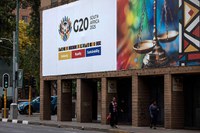
As of next year, the G20 will transform into an entirely different platform from what it has been for at least the past decade; away from development-oriented agendas and back to its original objective of global financial stability. Although the boycott by the US speaks to the diminishing relevance of the multilateral platform, the true effect will not be from the US’s exclusion in 2025, but from the priorities and values it spotlights in 2026. For SA and other developing economies, the US shift risks diminishing their influence on global governance, debt restructuring, climate financing and trade policy. As the G7 and G20 declarations carry no legal obligations, the Trump administration can disregard Johannesburg outcomes without challenge from other members.
THE 2025 G20 Summit is set to take place on 22 and 23 November in Johannesburg. The Summit represents the culmination of South Africa’s year-long G20 presidency and, if used well, should produce some level of common, shared communique or document that advances South Africa’s priorities and values.
The cause of SA’s 0.8% GDP average from 2012 to 2023 can seemingly never be the government’s chosen ideology and policies
Criminal actors are filling governance vacuums, especially in local municipalities
Suid-Afrika is besig om ’n gulde geleentheid te verspeel, waarsku Chris Hattingh ná ’n besoek aan Amerika, waar hy met meer as ’n dosyn regeringsamptenare en meningsvormers gesels het.
The pressure on those who work to support the jobless keeps rising in South Africa.
The main obstacle in tariff standoff is the party’s political will
BUSISIWE Mavuso, CEO of Business Leadership South Africa, recently wrote that the government must act urgently to mitigate the impact of United States (US) President Donald Trump’s tariffs on South Africa’s vehicle manufacturing sector. With the US being one of South Africa’s main vehicle export markets, heightened tariffs will pose a major risk to the local automotive sector. However, reciprocal tariffs are only a recent threat.
Notions in support of the AfCFTA will come to nought should the government not change its approach
Scant evidence in party rhetoric or actions to convince support will not decline.
Tariff threats have proved a favourite tool of US President Donald Trump as his administration continues to rework US trading relationships and the global trade order.
If police minister survives allegations he could challenge Paul Mashatile in race for ANC president
South Africa’s G20 Presidency provides the host country with numerous diplomatic, economic, and cultural opportunities. With a main summit (22-23 November in Johannesburg) preceded by numerous side conferences and engagements focused on a range of areas and sectors, South Africa’s G20 Presidency offers multiple chances to make a positive impact on international diplomatic and business counterparts.
Policies and legislation need to be questioned as transformation is failing black South Africans
Amidst the US-generated trade turmoil, Chinese president Xi Jinping announced last week that “zero-tariff treatment for 100% tariff lines” would be accorded to all 53 African nations that have diplomatic ties with China.
Over the course of the first five months of 2025, United States (US) President Donald Trump and his administration have worked – mostly using the threat of higher US tariffs on trading partners – to reform global trade. A 10% universal tariff baseline has been established; what remains are the various levels of reciprocal tariffs imposed on individual countries, with much dependent on those governments meeting with US officials to secure a (relatively) more favourable arrangement for their exports to the US.
For a country as reliant on trade and investment from the US and European countries as South Africa, the government’s focus on ideology and past grievances undermines its opportunity to seize the once-in-a-generation energy and impetus being administered to global trade and investment flows by the Trump administration.
![[Opinion] Response to Gulf crisis puts South Africans at risk](https://cra-sa.com/media/opinion-response-to-gulf-crisis-puts-south-africans-at-risk/@@images/04f4c005-c803-4d25-9c0c-d22a8f5c680e.jpeg "[Opinion] Response to Gulf crisis puts South Africans at risk")
![[Letter] Public sector growth masks private firms’ struggles](https://cra-sa.com/media/letter-public-sector-growth-masks-private-firms-struggles/@@images/38a74cbc-9d97-4408-9f64-7482c18a01c1.jpeg "[Letter] Public sector growth masks private firms’ struggles")
![[Letter] SA’s reliance on external tailwinds is risky](https://cra-sa.com/media/letter-sas-reliance-on-external-tailwinds-is-risky/@@images/d10bff07-8803-491d-8924-ba6b06587a97.jpeg "[Letter] SA’s reliance on external tailwinds is risky")
![[Opinion] US political risk for South Africa persists despite Congress gridlock](https://cra-sa.com/media/opinion-us-political-risk-for-south-africa-persists-despite-congress-gridlock/@@images/3a7b6f2d-a8fd-41db-ae04-73272ebd006c.jpeg "[Opinion] US political risk for South Africa persists despite Congress gridlock")
![[Opinion] Silencing the Guns? SA’s leadership amid persistent fire](https://cra-sa.com/media/opinion-silencing-the-guns-sas-leadership-amid-persistent-fire/@@images/1bcd1ba0-b3ad-4fa1-94d5-f43ceca8be7a.jpeg "[Opinion] Silencing the Guns? SA’s leadership amid persistent fire")
![[Letter] Agoa uncertainty harms wine sector](https://cra-sa.com/media/letter-agoa-uncertainty-harms-wine-sector/@@images/5614aec4-52e8-45b0-ae99-f8864d72b532.jpeg "[Letter] Agoa uncertainty harms wine sector")
![[News] Can SA take advantage of shifting global tides?](https://cra-sa.com/media/news-can-sa-take-advantage-of-shifting-global-tides/@@images/46ca5d99-28bf-4cd2-b346-2197886ccb41.jpeg "[News] Can SA take advantage of shifting global tides?")
![[Letter] Higher duties on imports won’t fix auto industry](https://cra-sa.com/media/letter-higher-duties-on-imports-wont-fix-auto-industry/@@images/3e1c99a6-eaeb-4864-bbb6-4e3769a49b05.jpeg "[Letter] Higher duties on imports won’t fix auto industry")
![[Opinion] ANC’s Iran posture is undermining SA’s national interests](https://cra-sa.com/media/opinion-ancs-iran-posture-is-undermining-sas-national-interests/@@images/d9ae7eb4-44ac-4a4c-8629-9bbb3f8ce211.jpeg "[Opinion] ANC’s Iran posture is undermining SA’s national interests")
![[Letter] Politics behind BAT plant closure](https://cra-sa.com/media/letter-politics-behind-bat-plant-closure/@@images/9f891d57-7f8d-4fa0-9289-b79039ca25a4.jpeg "[Letter] Politics behind BAT plant closure")
![[News] Is South Africa turning the corner? Data shows early signs of economic recovery](https://cra-sa.com/media/news-is-south-africa-turning-the-corner-data-shows-early-signs-of-economic-recovery/@@images/2b4e9fce-1297-49b3-9db9-af69290111b9.jpeg "[News] Is South Africa turning the corner? Data shows early signs of economic recovery")
![[Opinion] The fly in the MTBPS ointment](https://cra-sa.com/media/opinion-the-fly-in-the-mtbps-ointment/@@images/e7f8e5e6-e040-446f-9d4f-d05d586516e4.jpeg "[Opinion] The fly in the MTBPS ointment")
![[Opinion] ‘Back to basics’ future puts G20 at risk](https://cra-sa.com/media/opinion-back-to-basics-future-puts-g20-at-risk/@@images/7b9f23bd-5b3f-4daf-8b32-b727465a28a2.jpeg "[Opinion] ‘Back to basics’ future puts G20 at risk")
![[News] South Africa G20 Pragmatism vs Politics at the Summit](https://cra-sa.com/media/news-south-africa-g20-pragmatism-vs-politics-at-the-summit/@@images/a44ee1f9-c336-4d8b-82f2-83425234df0b.jpeg "[News] South Africa G20 Pragmatism vs Politics at the Summit")
![[Opinion] When will SA own its mistakes and stop blaming everything else?](https://cra-sa.com/media/opinion-when-will-sa-own-its-mistakes-and-stop-blaming-everything-else/@@images/9a87bfac-835c-4305-9b78-9704ec27af80.jpeg "[Opinion] When will SA own its mistakes and stop blaming everything else?")
![[Letter] Organised crime has its teeth in SA](https://cra-sa.com/media/letter-organised-crime-has-its-teeth-in-sa/@@images/83ab2d9c-5e30-4767-b03a-a9ac0432aa36.jpeg "[Letter] Organised crime has its teeth in SA")
![[Rapport] Selfs SA se pêlle in Washington raak nou keelvol](https://cra-sa.com/media/rapport-ontleding-selfs-sa-se-pelle-in-washington-raak-nou-keelvol/@@images/5f50e9ab-28be-4b11-a3a2-2573d402ceaf.jpeg "[Rapport] Selfs SA se pêlle in Washington raak nou keelvol")
![[Opinion] SA’s emerging demographic crisis: dependency on the rise](https://cra-sa.com/media/opinion-sas-emerging-demographic-crisis-dependency-on-the-rise/@@images/ae8ba2e4-2c98-4308-ab57-260410211feb.jpeg "[Opinion] SA’s emerging demographic crisis: dependency on the rise")
![[Letter] ANC policies impede SA-US trade](https://cra-sa.com/media/letter-anc-policies-impede-sa-us-trade/@@images/24382837-7404-4758-bcb1-664b50da2afe.jpeg "[Letter] ANC policies impede SA-US trade")
![[News] South Africa’s deindustrialisation dilemma](https://cra-sa.com/media/news-south-africas-deindustrialisation-dilemma/@@images/5e4cd922-8e5c-4fcb-84bf-686542df672d.jpeg "[News] South Africa’s deindustrialisation dilemma")
![[Letter] Trump tariff a chance to reform SA’s trade policies](https://cra-sa.com/media/letter-trump-tariff-a-chance-to-reform-sas-trade-policies/@@images/5befb67f-18b4-4415-8d03-1ebf9e56261c.jpeg "[Letter] Trump tariff a chance to reform SA’s trade policies")
![[Opinion] ANC heads for 30% in local government elections](https://cra-sa.com/media/opinion-chris-hattingh-anc-heads-for-30-in-local-government-elections/@@images/23cee276-bc84-4e65-9759-aec159fb260b.jpeg "[Opinion] ANC heads for 30% in local government elections")
![[Opinion] The ongoing tariff dance](https://cra-sa.com/media/opinion-the-ongoing-tariff-dance/@@images/5e220779-a8b6-4ce6-a2e7-1d8387e96ded.jpeg "[Opinion] The ongoing tariff dance")
![[Letter] Probe blow to Mchunu’s ambitions](https://cra-sa.com/media/letter-probe-blow-to-mchunus-ambitions/@@images/a30e87d0-8a4f-43ca-a958-69206bafe257.png "[Letter] Probe blow to Mchunu’s ambitions")
![[News] South Africa’s G20 Presidency: What It Means for Global Trade & Investment](https://cra-sa.com/media/news-south-africas-g20-presidency-what-it-means-for-global-trade-investment/@@images/3117e474-9bef-490f-bdd3-34d0c7f43dc0.jpeg "[News] South Africa’s G20 Presidency: What It Means for Global Trade & Investment")
![[Opinion] CHRIS HATTINGH: Is SA serious about growth?](https://cra-sa.com/media/opinion-chris-hattingh-is-sa-serious-about-growth/@@images/87a00605-b342-4442-a83e-645c32973019.jpeg "[Opinion] CHRIS HATTINGH: Is SA serious about growth?")
![[Opinion] SA dithers while global trade shifts](https://cra-sa.com/media/opinion-sa-dithers-while-global-trade-shifts/@@images/0a651c7a-23a1-4511-a259-d2173a27d216.jpeg "[Opinion] SA dithers while global trade shifts")
![[News] US tariffs 2025: 31% blow to South African exports](https://cra-sa.com/media/news-us-tariffs-2025-31-blow-to-south-african-exports/@@images/ef0dff95-d6e3-4a5b-a6d4-744929cceeaa.jpeg "[News] US tariffs 2025: 31% blow to South African exports")
![[Opinion] SA’s once-in-a-century opportunity](https://cra-sa.com/media/opinion-sas-once-in-a-century-opportunity/@@images/20960aac-407f-45a1-b9d0-7d285161993d.jpeg "[Opinion] SA’s once-in-a-century opportunity")